Over nearly five and a half years of the Second World War, more than a million Canadians served in the North Atlantic, Italy, Hong Kong, the Netherlands, France and Germany. One Canadian in eleven took part in the war, and more than 40,000 people lost their lives. It was a long and bloody war. To learn more about the victory celebrations in the metropolis, visit montrealyes.com.
Victory Day for Canadians
It should first be noted that Canadians took part in every theatre of military operations during the Second World War, but most of them fought in Europe and the North Atlantic. As a result, those who fought in Asia are generally talked about, written about and paid far less attention.
However, it is known that in the Far East, from 1939 until the end of the war, about 1000 Canadians fought. After Germany's surrender, the idea of transferring to Asia the troops no longer needed in Europe at that point was considered. But these plans never materialized, because on August 6 and 9, the American atomic strikes on Hiroshima and Nagasaki brought the war in that region to an end.
Emperor Hirohito announced Japan's surrender to the Allies in a radio broadcast on August 15. The official end came on September 2, when the instrument of surrender was signed. Canadians in general, and Montrealers in particular, therefore had good reason to rejoice.
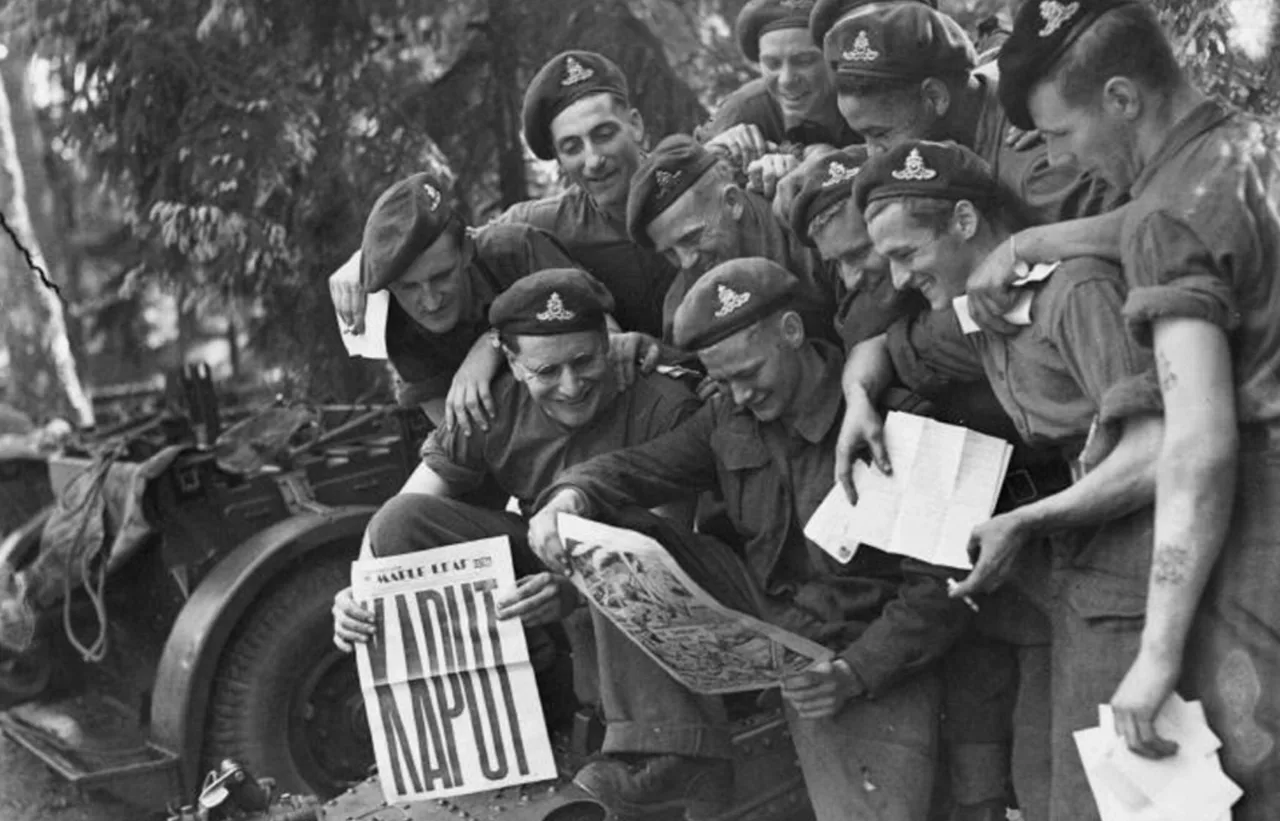
By May 8, the news of Germany's surrender was official, and that day holidays were proclaimed in honour of Victory Day. It was also reported that the following day, people celebrated the victory even more fervently.
And when news of Japan's surrender spread, just as on Victory Day, Canadians left their offices and homes to celebrate in the streets. Cities with large Chinese communities, such as Montreal and Vancouver, threw themselves into the celebrations even more, since much of China had been occupied by Japan even before the war.
Later, these communities organized their own parades to celebrate the end of the war and to honour those who had not been able to come home and celebrate with their loved ones. Incidentally, Prime Minister Mackenzie King was in San Francisco at the time, attending the founding conference of the United Nations. But on May 8, he gave a radio address calling on people to rejoice in the victory.
Students celebrate
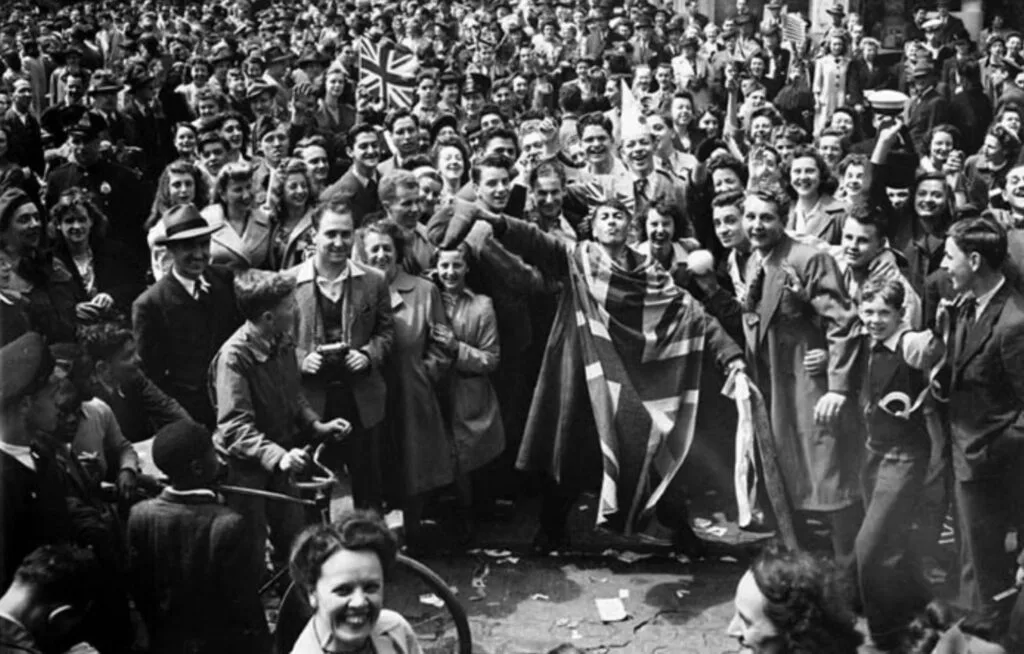
The celebrations in Montreal were just as grand and spectacular. On May 8, 1945, end-of-term exams at McGill University were interrupted by spontaneous celebrations that began at 9 a.m., after the official announcement of the end of the war in Europe.
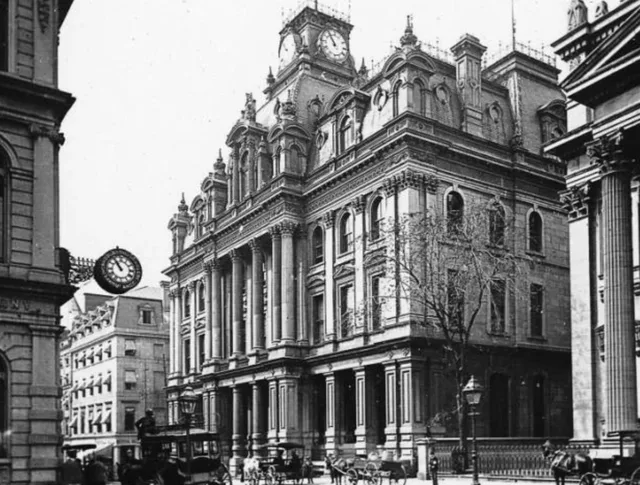
Large groups of students and teachers began celebrating at their alma mater, then made their way to Sainte-Catherine Street to join the huge crowd of Montrealers that had spontaneously gathered in Phillips Square, Dominion Square and at the corner of Piel and Sainte-Catherine streets. It was a tremendous outpouring of positive emotion that eventually turned into a great street party and, with it, brought immense relief to society.
Indeed, as is well known, the war had a considerable impact on the university. Although enrolment remained more or less stable throughout the conflict, at just over 3,000 students, the usual rhythm and outlook of campus life changed considerably. This is hardly surprising, since the whole city had adapted to the demands of the war.
The end of the conflict therefore brought great relief, even though the university had to face new challenges. Financial hardship during the Great Depression, followed by the focus of all attention and effort on wartime priorities, had led to the decline of the campus. The buildings, lecture halls, libraries and equipment urgently needed repair, renovation and expansion.
The problem was recognized, and the fundraising campaign, which had in fact been launched as early as 1943, resumed. Seven million dollars was raised for all the necessary work. At the same time, in response to changing economic and social demands, new programs of study had to be added.
A more pressing problem was that enrolment had more than doubled in 1946, as returning veterans took advantage of the federal education program under the Veterans Charter. To cope with the influx of new students, temporary premises had to be found. This is how Dawson College in Saint-Jean was created; it came into being quickly and efficiently as an auxiliary campus and opened its doors in September 1945.
Festivities in the streets
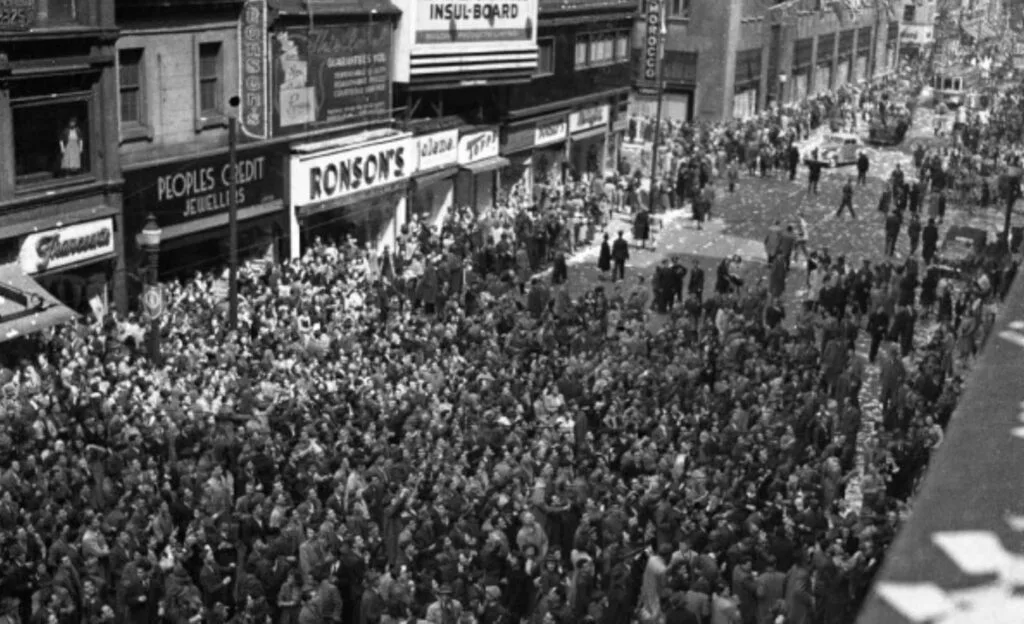
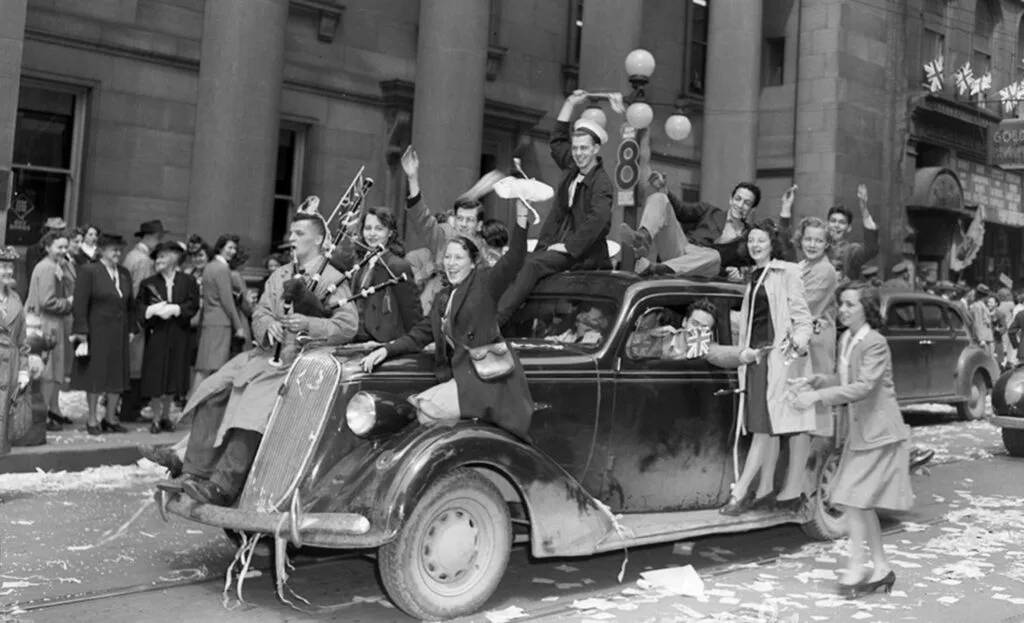
In Montreal, Sainte-Catherine Street became the main site of the end-of-war celebrations. The Gazette newspaper described the joy of Montrealers, especially motorists, who honked their horns and zigzagged through the streets. At the same time, pedestrians flooding the street tried to hang on to the cars' "spare tires", lay on the hoods, and clung to the fenders and radiator caps, riding along with the cars and greeting the drivers. The joy was wild.
It had been a long time since Sainte-Catherine Street had been so crowded. And all these people enjoying the spring sunshine were not celebrating a Stanley Cup win, but the triumph of the Allies over Nazi Germany.
Although the war did not officially end until September, the certainty that this exhausting conflict was over was so strong that it filled Montrealers with boundless joy. Like most people in the Western world, they were barely emerging from an unprecedented economic crisis and had just lived through six years of war. Some residents proudly flew the British flag, the Union Jack.
It was, in fact, under this flag that Canadian soldiers officially fought during the Second World War. Although Canada had been free to conduct its own diplomatic policy since 1931, attachment to Britain remained quite strong, especially in the English-speaking community concentrated in the western part of Montreal. The years that followed were marked by prosperity and modernization, then by the "Quiet Revolution", which transformed the look of the streets, the city and the entire province.
Proud in uniform
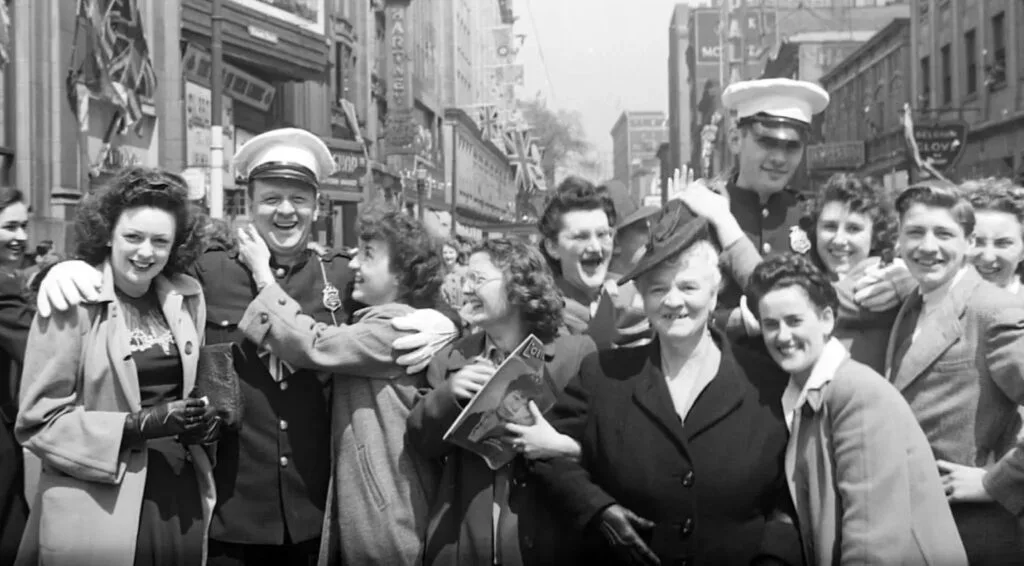
But today, almost all Montrealers had gathered on Sainte-Catherine Street, no matter what language they spoke, what they believed or what they wore. Some, for example, wore uniforms that set them apart from the crowd. Not everyone could tell their military rank, but the service they belonged to was easy to identify. Their jackets and caps showed that they were officers of the Royal Canadian Air Force. On their chests they wore special badges: a laurel wreath with a wing. These badges indicated an air gunner or a bomb aimer.
It was just as easy to spot the young sailors of the Royal Canadian Navy at the celebration, thanks to their slender figures and the neckline of their sweaters, which by today's standards gave them a feminine look. In fact, it was unthinkable at the time for a woman to wear such a uniform. For women in the military, a button-up shirt and tie were mandatory. However, the navy can proudly add another wartime achievement to its record: it was the first branch of the Canadian Armed Forces to recruit women. By the end of the war, there were reportedly about 6,000 of them.
Sources:
- https://reporter.mcgill.ca/il-y-a-80-ans-la-fin-de-la-seconde-guerre-mondiale-apportait-son-lot-de-defis-et-de-changements-a-mcgill/
- https://www.journaldemontreal.com/2018/06/09/la-guerre-est-finie
- https://jemesouviens.org/en/ve-day/