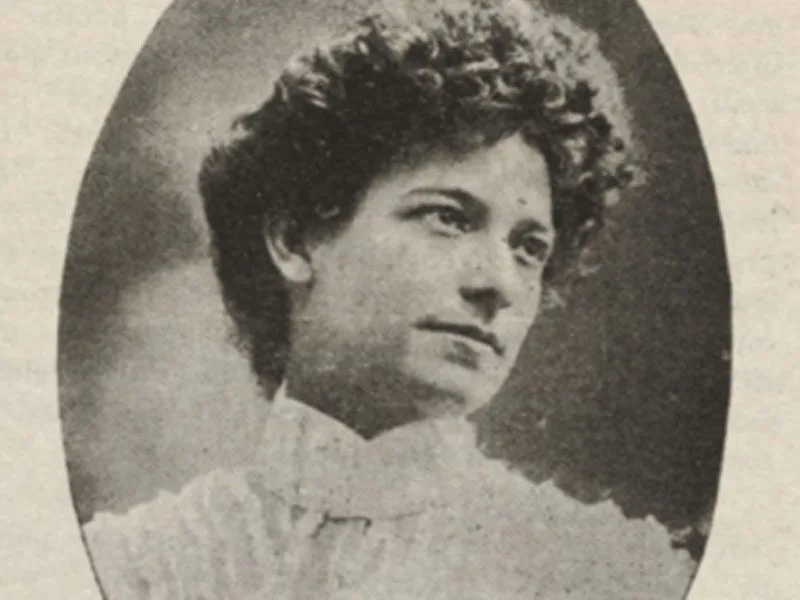
Idola Saint-Jean was one of the most influential suffragettes of the 20th century. She devoted her life to the fight for women's right to vote and to reform of the Civil Code in the province of Quebec. She spoke on the radio, took part in demonstrations and parliamentary hearings, and wrote briefs as well as newspaper articles to promote feminism among Quebecers. To learn more, visit montrealyes.
Youth
Idola Saint-Jean was born on May 19, 1880, in Montreal. She grew up in a lawyer's family. She went to secondary school at the Villa-Maria school, run by the nuns of the Congrégation de Notre-Dame de Montréal, where she studied writing, arithmetic, reading, geography and history. Idola Saint-Jean also took diction and stage direction classes at Julia Bennati's theatre school, which allowed her to develop excellent public speaking skills.
From the age of twenty, Idola began a career as an actress in theatres in Montreal and other Quebec cities. To make a living, she also taught diction and public speaking at Villa-Maria and other schools in the city. In 1903, she went to Paris to take lessons from the famous actor Constant Coquelin and also attended classes at the Sorbonne.
When she returned to Canada, Idola Saint-Jean became a French professor at McGill University. It was there that she met Carrie Derick, known as the first woman to become a full professor at a Canadian university.
Alongside her teaching, Idola Saint-Jean began to take an active part in social causes. She gave public diction classes and worked as secretary of the Catholic committee of the Montreal court, where she handled cases involving young offenders. During the First World War, she headed an emergency relief committee.
Political career
In 1922, Idola, together with Marie Lacoste Gérin-Lajoie and Anna Marks Lyman, founded the Comité provincial pour le suffrage féminin. In February 1922, a delegation of 400 to 500 women met with the premier of Quebec, Louis-Alexandre Taschereau, to persuade the government to support a bill giving women the right to vote in provincial elections. However, the idea was put off after second reading.
In 1927, Idola Saint-Jean founded the Alliance canadienne pour le vote des femmes du Québec, an organization that was especially concerned with improving the legal situation of women from poor families. Around the same time, Thérèse Casgrain turned the Comité provincial pour le suffrage féminin into the Ligue des droits de la femme, which was aimed more at middle-class and upper-class women. Every year, Idola and Thérèse introduced various bills in Quebec City to overcome opposition to granting women the right to vote.
At the same time, Idola Saint-Jean worked to improve the Civil Code. Before the Dorion Commission, she asked for the legal age of marriage to be raised to 16, when at the time it was 14 for boys and 12 for girls. She also insisted that women should have the same right as their husbands to refuse their children's marriage, to withdraw money from an insurance policy, and so on. The commission's findings were published on February 15, 1930. They abolished the requirement for a woman to obtain her husband's permission to dispose of her own property, raised the marriage age for women to 14 and gave them the right to act as witnesses when a notarial will was signed.
First woman to run for federal Parliament
In 1930, Idola Saint-Jean ran in the federal election in the riding of Montréal-Dorion-Saint-Denis, becoming the first woman candidate in Quebec's history. Although she knew she had little chance of being elected, she used the opportunity to draw attention to the need to give women the right to vote. In the end, she won 3,000 votes.
Through her political activism, Idola Saint-Jean played a crucial role in winning the right to vote for Quebec women, which came into effect on April 25, 1940.